Kubernetes
A cheat sheet for Kubernetes commands.
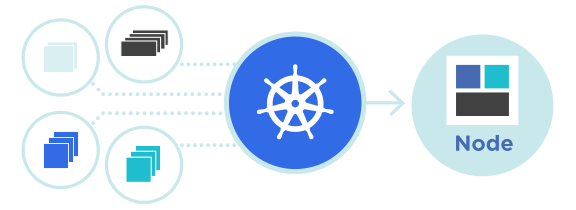
Kubernetes Cheat Sheet
A cheat sheet for Kubernetes commands.
Kubectl Alias
Linux
alias k=kubectl
Windows
Set-Alias -Name k -Value kubectl
Cluster Info
- Get clusters
kubectl config get-clusters
NAME
docker-for-desktop-cluster
foo
- Get cluster info.
kubectl cluster-info
Kubernetes master is running at https://172.20.0.58:8443
Contexts
A context is a cluster, namespace and user.
- Get a list of contexts.
kubectl config get-contexts
CURRENT NAME CLUSTER AUTHINFO NAMESPACE
docker-desktop docker-desktop docker-desktop
* foo foo foo bar
- Get the current context.
kubectl config current-context
foo
- Switch current context.
kubectl config use-context docker-desktop
- Set default namesapce
kubectl config set-context $(kubectl config current-context) --namespace=my-namespace
Get Commands
kubectl get all
kubectl get namespaces
kubectl get configmaps
kubectl get nodes
kubectl get pods
kubectl get rs
kubectl get svc
kubectl get endpoints <svcname>
Additional switches that can be added to the above commands:
-o wide- Show more information.--watchor-w- watch for changes.
Namespaces
--namespace- Get a resource for a specific namespace.
You can set the default namespace for the current context like so:
kubectl config set-context $(kubectl config current-context) --namespace=my-namespace
Labels
- Get pods showing labels.
kubectl get pods --show-labels
- Get pods by label.
kubectl get pods -l environment=production,tier!=frontend
kubectl get pods -l 'environment in (production,test),tier notin (frontend,backend)'
Describe Command
kubectl describe nodes [id]
kubectl describe pods [id]
kubectl describe rs [id]
kubectl describe svc [id]
kubectl describe endpoints <svcname> [id]
Delete Command
kubectl delete nodes [id]
kubectl delete pods [id]
kubectl delete rs [id]
kubectl delete svc [id]
kubectl delete endpoints <svcname> [id]
Force a deletion of a pod without waiting for it to gracefully shut down
kubectl delete pod-name --grace-period=0 --force
Create vs Apply
kubectl create can be used to create new resources while kubectl apply inserts or updates resources while maintaining any manual changes made like scaling pods.
--record- Add the current command as an annotation to the resource.--recursive- Recursively look for yaml in the specified directory.
Create Pod
kubectl run <name> --generator=run-pod/v1 --image=<imagename:tag> --output yaml --export --dry-run > <name>.yml
kubectl apply -f <name>.yml
Create Deployment
kubectl run <name> --image=<imagename:tag> --output yaml --export --dry-run > deployment.yml
kubectl apply -f deployment.yml
Create Service
kubectl expose deployment <servicename> --port 8080 --target-port=8080 --output yaml --export --dry-run > <servicename>.yml
kubectl apply -f <servicename>.yml
Export YAML for New Pod
kubectl run my-cool-app -image=me/my-cool-app:v1 --output yaml --export --dry-run > my-cool-app.yaml
Export YAML for Existing Object
kubectl get deployment my-cool-app --output yaml --export > my-cool-app.yaml
Logs
- Get logs.
kubectl logs -l app=<appname>
- Get logs for previously terminated container.
kubectl logs POD_NAME --previous
- Watch logs in real time.
kubectl attach POD_NAME
- Copy files out of pod (Requires
tarbinary in container).
kubectl cp POD_NAME:/var/log .
Port Forward
kubectl port-forward deployment/<deploymentname> 8080:8080
Scaling
- Update replicas.
kubectl scale deployment nginx-deployment --replicas=10
Autoscaling
- Set autoscaling config.
kubectl autoscale deployment nginx-deployment --min=10 --max=15 --cpu-percent=80
Rollout
- Get rollout status.
kubectl rollout status deployment/nginx-deployment
Waiting for rollout to finish: 2 out of 3 new replicas have been updated...
deployment "nginx-deployment" successfully rolled out
- Get rollout history.
kubectl rollout history deployment/nginx-deployment
kubectl rollout history deployment/nginx-deployment --revision=2
- Undo a rollout.
kubectl rollout undo deployment/nginx-deployment
kubectl rollout undo deployment/nginx-deployment --to-revision=2
- Pause/resume a rollout
kubectl rollout pause deployment/nginx-deployment
kubectl rollout resume deploy/nginx-deployment
Pod Example
apiVersion: v1
kind: Pod
metadata:
name: cuda-test
spec:
containers:
- name: cuda-test
image: "k8s.gcr.io/cuda-vector-add:v0.1"
resources:
limits:
nvidia.com/gpu: 1
nodeSelector:
accelerator: nvidia-tesla-p100
Deployment Example
apiVersion: apps/v1
kind: Deployment
metadata:
name: nginx-deployment
namespace: my-namespace
labels:
- environment: production,
- teir: frontend
annotations:
- key1: value1,
- key2: value2
spec:
replicas: 3
selector:
matchLabels:
app: nginx
template:
metadata:
labels:
app: nginx
spec:
containers:
- name: nginx
image: nginx:1.7.9
ports:
- containerPort: 80
Dashboard
- Enable proxy
kubectl proxy
Azure Kubernetes Service
Get Credentials
az aks get-credentials --resource-group <Resource Group Name> --name <AKS Name>
Show Dashboard
az aks browse --resource-group <Resource Group Name> --name <AKS Name>
Upgrade
Get updates
az aks get-upgrades --resource-group <Resource Group Name> --name <AKS Name>
For More please Visit Kubernetes Documentation
Follow me on : Medium Linkedin Researchgate